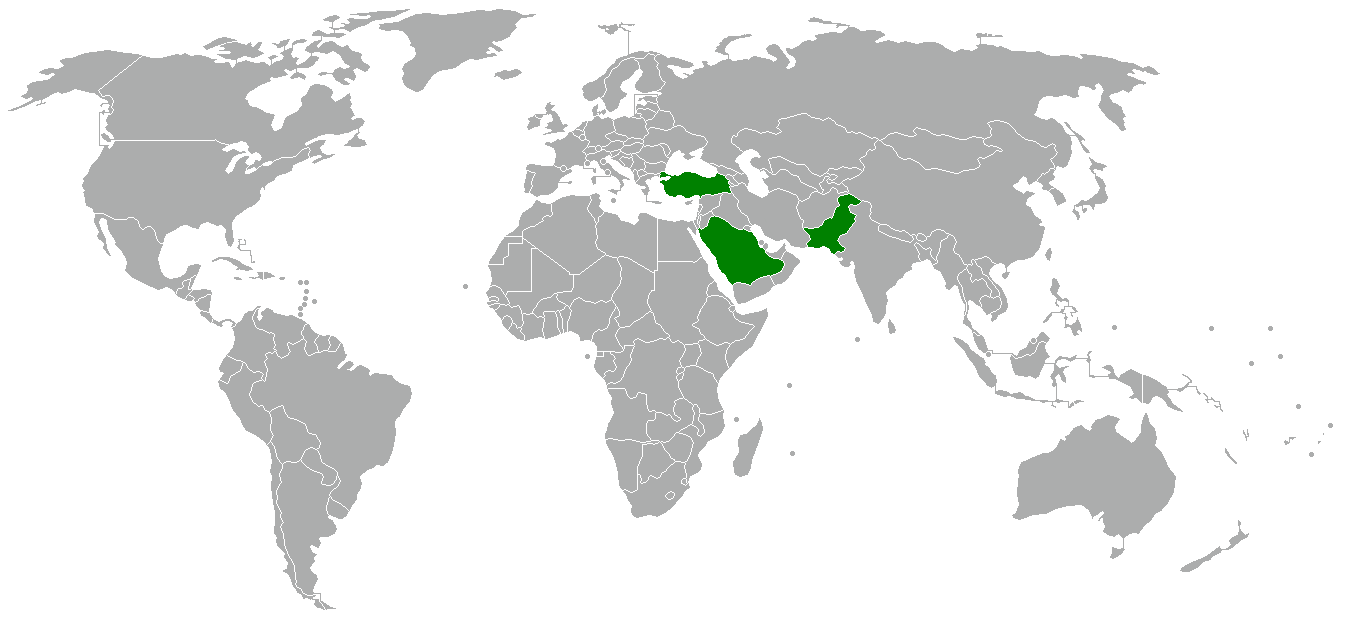
On August 7, Turkey, Saudi Arabia and Pakistan signed a joint defence agreement pledging that an armed attack against one would be regarded as an attack against all three. The agreement resembles NATO’s Article 5 commitment to collective defence. More importantly, however, it was signed during the war with Iran and the wider conflict in the Gulf region. In this context, the agreement can be seen as part of a broader reshaping of how states perceive security threats and their role in responding to them.
This alignment did not begin with the war. Rather, the war accelerated a relationship that was already taking shape. The main point is not that the conflict suddenly created the alliance, but that growing regional uncertainty increased the urgency of formalising it. The three states appear to be building an additional layer of security rather than relying on any single existing arrangement.
What changed
The alignment between Turkey, Saudi Arabia and Pakistan did not begin with the current war. Trilateral meetings and negotiations had already been taking place for roughly a year, and by early 2026 a draft agreement had been prepared. What changed was the level of commitment. On August 7, the three countries formalised their relationship through a joint defence agreement, under which an armed attack against one would be regarded as an attack against all three.
The timing is important. The agreement was signed during the war involving Iran and growing instability across the Gulf. A relationship that had previously been developing through meetings and defence cooperation was therefore turned into a more explicit security commitment. The war did not create the alignment, but it appears to have increased the urgency of formalising it.
Why it happened
The first reason may be deterrence. Saudi Arabia had already faced attacks from Iran-aligned groups, while Tehran was threatening retaliation against Gulf infrastructure if the war widened. In such an environment, a stronger collective defence commitment could increase the potential cost of an attack. The agreement may therefore have been formalised, at least in part, not simply to prepare for a wider conflict but to make one less likely.
At the same time, deterrence creates its own risks. Alliance commitments may reduce the likelihood of an attack, but they can also increase the risk of entanglement if deterrence fails. If a confrontation between Saudi Arabia and an Iran-backed group escalates, for example, the question would no longer be only how Riyadh responds. How Turkey and Islamabad interpret their commitments under the agreement would also become significant.
For Turkey, recent developments around the Kurdish issue, particularly its dimension in Iraq, may also be relevant to its broader security calculations. Turkey’s long-running conflict with the PKK has an important connection to northern Iraq. If the regional war spreads further into Iraq, or if the security environment becomes more unstable, Turkey could find itself managing several security fronts at the same time. Reducing or eventually ending the conflict with the PKK could therefore give Turkey greater room for manoeuvre in the event of a wider regional crisis.
This does not necessarily mean that Turkey is preparing to enter another war. It does, however, raise a question about timing: why is Turkey attempting to reduce one security threat connected to Iraq while simultaneously strengthening a new defence arrangement with Saudi Arabia and Pakistan? The two developments may not be directly connected, but they could form part of the same broader effort to reduce Turkey’s exposure to regional instability. That question became more relevant on August 10, when parliament approved legislation that would advance the PKK disarmament process once full disarmament is verified.
What it means
The agreement suggests that the three countries are not necessarily abandoning their existing alliances or security relationships. Instead, they appear to be adding another layer to them. Turkey remains connected to NATO, while Saudi Arabia and Pakistan maintain their own relationships with major external powers. The new alignment may therefore be better understood as an additional security arrangement rather than the beginning of a completely separate bloc.
This matters because periods of war can change what states expect from alliances. When regional security becomes less predictable, relying on a single partner or security structure may no longer appear sufficient. States may instead try to create several overlapping relationships that give them more room to respond to different threats. The agreement between Turkey, Saudi Arabia and Pakistan may be an example of this kind of layered security.
There is also a historical parallel. During the Cold War, Turkey and Pakistan were part of the Baghdad Pact and later CENTO, which connected the Middle East and South Asia within a Western-backed security framework. The United States supported the system even though it never became a full member of CENTO. Today’s alignment looks familiar in that sense, but the logic is not exactly the same. Turkey, Saudi Arabia and Pakistan are not simply joining a structure built by an outside power. Instead, they are creating an additional regional security arrangement while keeping their existing alliances. This suggests that periods of war and uncertainty still push states to build new security ties, although today those ties may be driven more by regional actors themselves.
Yet whether this makes the region safer remains uncertain. The same collective commitment that may deter an attack can also widen a conflict once an attack occurs. The agreement therefore creates two opposing possibilities: it may discourage further escalation by raising the cost of confrontation, or it may draw additional states into a conflict if deterrence fails.
The more important question may therefore not be whether Turkey, Saudi Arabia, and Pakistan are preparing to fight a war together. It is whether the possibility that they might is enough to prevent a wider war from taking place.
The pact’s real test may not be whether its members are willing to fight together, but whether the possibility that they might is enough to prevent a wider war.
What to watch
The first ministerial meeting. This will show whether the agreement develops from a political commitment into practical defence coordination.
The first test of deterrence. A new major attack on Saudi or Gulf infrastructure would show how Turkey and Islamabad interpret their collective-defence commitments — and whether the pact deters escalation or risks widening it.
The PKK disarmament process. Further progress would make Turkey’s effort to reduce its security exposure in Iraq an important part of the wider regional picture.