Economic growth is one of the easiest commitments that governments give to their people. GDP rises, exports break records, new factories open, and the numbers seem to point in one direction: progress. But growth and development are not quite the same thing.
An economy can become larger without becoming significantly more productive, technologically capable, or economically resilient. It can export more while becoming increasingly dependent on imported machinery and intermediate goods. It can attract foreign capital without developing the domestic knowledge needed to compete with that capital. In other words, growth can be real while the transformation we normally associate with development remains incomplete.
This does not make GDP useless, nor does it mean that international trade is harmful. The issue is more subtle. GDP tells us how much economic activity is taking place, whereas development shows us what that growth is turning the country into.
Turkey offers a particularly useful case for examining this distinction. Over the past two decades, the country has expanded its exports dramatically, developed a substantial manufacturing base, and integrated more deeply into global markets. These may seem like real achievements. However, its dependence on imported intermediate goods and technology has remained significant, while the technological composition of its exports has changed much more slowly.
The Turkish case therefore raises a broader question relevant to many developing economies: Does producing and exporting more necessarily mean that a country is developing?
Growth is a measure of size, not necessarily transformation
GDP does what it is designed to do reasonably well: it measures the value added generated within an economy. Imports are not simply counted as domestic production. Under the expenditure approach, they are subtracted when GDP is calculated. If a Turkish company imports a machine from Germany, the full value of that machine does not magically become Turkish GDP. The limitation lies elsewhere.
Suppose two countries both grow by 5 percent. In the first country, firms invest in advanced machinery, domestic research produces new technologies, workers move into more productive industries, and local companies gradually become capable of designing and producing sophisticated goods. In the second, growth comes largely from construction, consumption, imported technology and industries that perform relatively simple stages of production.
Both countries have grown. But it would be difficult to argue that they have developed in exactly the same way. Economic development is therefore partly about structural change. It concerns productivity, technological capability, human capital and the ability of an economy to move toward activities that generate greater value. It also concerns living standards and the distribution of the benefits of growth. A larger economy is useful, but size alone cannot tell us whether those deeper changes are taking place.
This distinction becomes especially important for countries trying to catch up with already industrialised economies. A developing country does not enter the world market with the same accumulated capital, technology, institutions or corporate knowledge as Germany, the United States, Japan or South Korea. Simply participating in the same market does not automatically erase those differences. Turkey illustrates the problem quite clearly.
Turkey produces a great deal
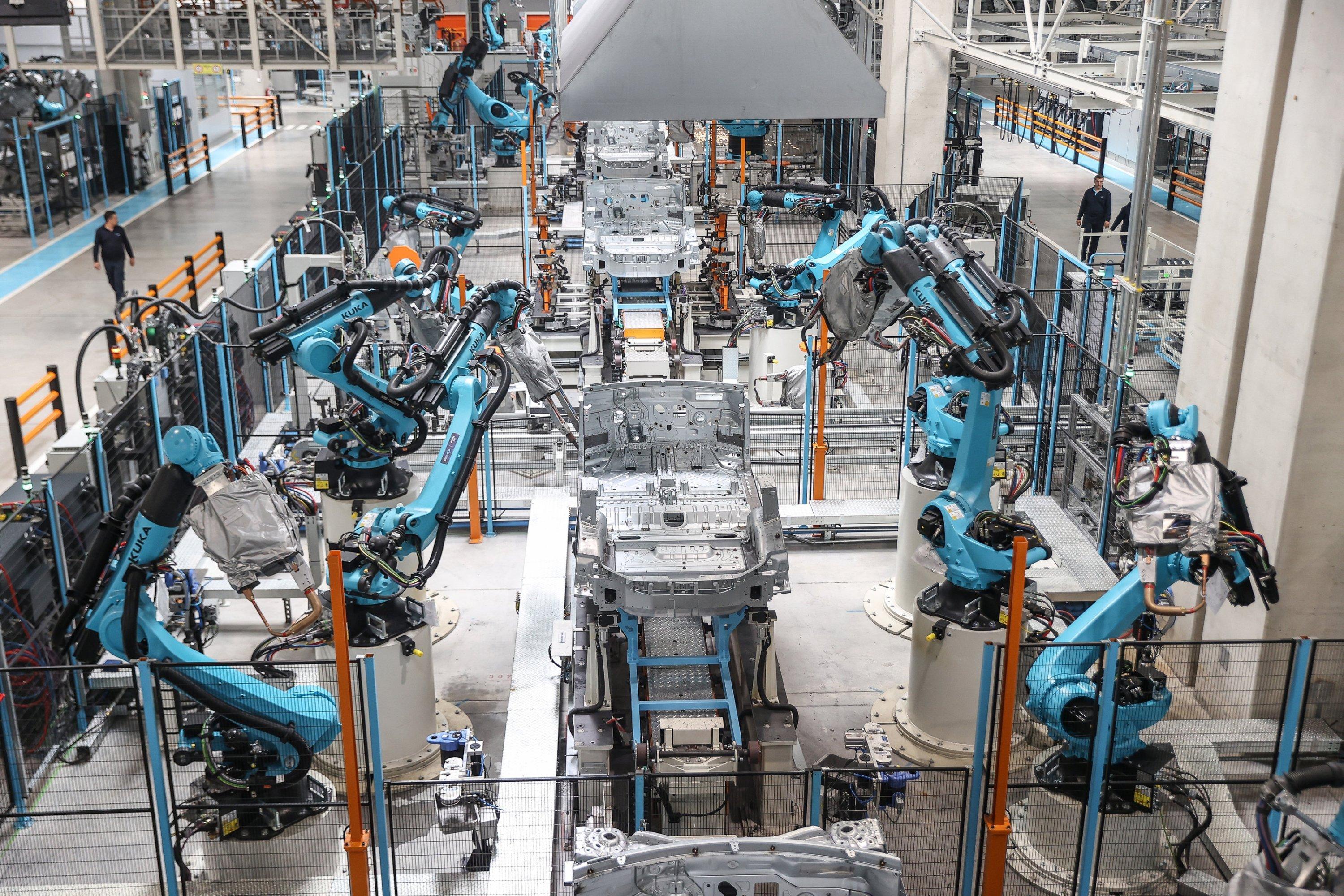
That is not the problem. The popular image of Turkey as an economy that “does not produce anything” is difficult to reconcile with the data. In 2024, Turkey exported roughly $261.9 billion worth of goods. Manufacturing accounted for 94.1 percent of its exports. It is an important producer of automobiles, machinery, electrical equipment, textiles, metals, household appliances, and many other manufactured products.
The more interesting part appears when we look at what Turkey imports alongside what it exports. In the same year, imports amounted to roughly $344.1 billion, leaving a merchandise trade deficit of about $82.2 billion. More strikingly, 69.3 percent of imports consisted of intermediate goods: inputs that businesses use in further production rather than products purchased directly for final consumption. That distinction changes the nature of the discussion.
Turkey’s import bill is not simply the result of consumers buying foreign phones, cars, or luxury goods. Much of it is connected to production itself. Take machinery. In 2024, Turkey exported around $25.6 billion worth of general machinery but imported approximately $39.6 billion. Electrical equipment shows a similar pattern: around $16.4 billion in exports against $27.2 billion in imports. In iron and steel, exports were about $10.2 billion, compared with imports of roughly $23.7 billion. Motor vehicles were one of the notable exceptions, with exports and imports both around $32 billion. The data do not describe a country without industry. They describe an industrial economy that continues to purchase a considerable amount of the machinery, components and materials on which that industry depends.
Energy complicates the picture further. Turkey imported about $65.6 billion in mineral fuels in 2024, but this cannot simply be treated as a failure of industrial policy. Turkey does not possess the oil and natural-gas reserves of countries such as Saudi Arabia or Russia. Geography matters. For this reason, talking about “import dependence” as though it were one single problem is not very helpful.
Dependence on imported energy is different from dependence on industrial machinery. Dependence on semiconductors is different from dependence on raw materials. And importing something is not necessarily a weakness at all if that import enables a country to produce something more sophisticated in return.
The real question is not whether Turkey imports. It is what Turkey learns to produce as a result of those imports.
The technology gap is harder to ignore
This is where Turkey’s export numbers become more revealing. If more than 94 percent of a country’s exports come from manufacturing, one might expect a relatively strong presence in technologically advanced products. Yet in 2024, high-technology products accounted for only 3.6 percent of Turkey’s manufacturing exports. In manufacturing imports, the corresponding share was 11.1 percent. A single year could be dismissed as an anomaly. The longer trend cannot.
The OECD reports that high-technology products have represented only around 3.5 percent of Turkey’s manufactured exports for roughly the past twelve years. By comparison, the share exceeds 20 percent among upper-middle-income countries as a group. Turkey has made more visible progress in medium-high-technology manufacturing—the share rose from 32.2 percent in 2015 to 37.5 percent in 2024—but the transition toward the most technology-intensive forms of production remains limited.
This makes the Turkish case more interesting than the simple argument that “exports are good” or “imports are bad.” Turkey clearly has an export economy. It clearly has manufacturing. It has also moved into more sophisticated industries over time. Yet the technological core of that transformation has been much weaker than the expansion in the overall volume of trade. One way to see this more clearly is to stop looking only at the final price of exported goods.
A car may leave a Turkish factory and be recorded as a Turkish export. But that car contains hundreds of separate inputs: electronics, chemicals, specialised metals, software, industrial machinery and components that may have crossed several borders before final assembly. Conventional trade statistics tell us where the finished product was exported from. They do not tell us where all of its value was created.
Looking inside exports
This is the purpose of the OECD’s Trade in Value Added (TiVA) data. Rather than treating the entire value of a finished export as economically domestic, TiVA attempts to trace how much value was created inside the exporting country and how much came from foreign inputs.
For Turkey, the result is revealing. The foreign value-added content of gross exports increased from 21.3 percent in 2010 to 27.3 percent in 2022. This means that slightly more than a quarter of the value embodied in Turkish exports originated abroad by 2022. But this number needs to be interpreted carefully.
It would be easy to look at 27.3 percent and conclude that Turkey’s integration into global production is itself the problem. That conclusion does not survive comparison with successful industrial economies.
South Korea is a good example. In 2022, foreign value added accounted for 36.7 percent of South Korea’s gross exports—considerably more than Turkey’s share. If foreign inputs automatically prevented development, South Korea should be performing worse than Turkey. Clearly, it is not. The difference is what happens around those imported inputs.
South Korea imports energy, raw materials, components and intermediate goods on a massive scale, but it has also built domestic capabilities in semiconductors, electronics, automobiles, chemicals, shipbuilding and industrial technology. Its ICT and electronics sector is deeply tied to world demand; OECD data show that 70.9 percent of the domestic value added generated in that sector was driven by foreign final demand in 2022. South Korea therefore gives us an important correction to the original hypothesis. Development does not require economic self-sufficiency.
In a modern economy, trying to manufacture every input domestically would often be expensive and inefficient. The real objective is not to eliminate dependence on other countries. No advanced economy has done that. A stronger form of economic independence exists when dependence becomes mutual.
South Korea needs resources and inputs from the global economy, but the global economy also needs Korean semiconductors, ships, batteries, electronics and industrial knowledge. Its position in global value chains is therefore different from that of an economy whose role remains concentrated in more replaceable stages of production.
This gives us a better definition of development: The question is not whether a country depends on the world economy, but whether it develops capabilities that make the world economy depend on it as well.
Turkey’s integration was successful, but incomplete
This distinction also prevents the argument from becoming an unfair rejection of Turkey’s economic experience since the early 2000s. Turkey did achieve substantial progress.
The World Bank notes that between 2001 and 2017, Turkish real income per capita roughly doubled. By around 2014, the country had come close to entering the high-income category. Foreign direct investment, export growth and participation in global value chains all contributed to this expansion.
Global integration also appears to have benefited many individual firms. According to the World Bank, Turkish exporters participating in global value chains are roughly twice as productive as the average domestic firm and employ around four times as many workers.
So opening the economy, attracting foreign investment and becoming part of international production networks did not simply “destroy” Turkish industry. That interpretation would ignore a large amount of evidence. The difficulty is what came next.
The World Bank also finds that Turkey’s participation in high-value global production networks remains relatively limited, while the sophistication of its products and gains in innovation have remained weaker than they could have been. This is where the difference between growth and development becomes visible.
The first stage—producing more, exporting more, attracting investment and integrating into international markets—was relatively successful. The second stage—using that integration to build deeper domestic technological capabilities—has been much more difficult.
The periods after the global financial crisis make the distinction even clearer. Turkey experienced different combinations of strong domestic credit growth, capital inflows, exchange-rate pressure and later currency depreciation. After 2013, and especially after 2018, a weaker lira sometimes reduced imports and improved certain external-balance indicators. But a fall in imports does not necessarily mean successful industrialisation.
Imports can fall because domestic firms have learned to produce machinery that was previously purchased abroad. They can also fall because imported machinery has simply become too expensive. The trade balance improves in both cases. Only one represents development. That is why looking at GDP growth or the current-account balance alone can produce an incomplete picture.
The external constraint on growth
There is an economic model that helps explain why this production structure matters. Anthony Thirlwall’s balance-of-payments-constrained growth model starts from a relatively simple idea. Over long periods, countries cannot allow imports to grow much faster than the foreign currency they can earn through exports and other sustainable external revenues.
In simplified form:
gBOP ≈ x / π
where (x) represents export growth and (π) represents the responsiveness of imports to rising domestic income.
The intuition matters more than the formula. Imagine that every time the Turkish economy expands, its factories require substantially more imported machinery, components, chemicals, and energy. Growth increases imports. To pay for them, Turkey needs export revenues, foreign investment, borrowing or reserves.
If exports and other sustainable foreign-currency earnings cannot keep pace, the economy eventually encounters an external constraint. Financing becomes harder, pressure on the currency grows and imports become more expensive. Investment and consumption weaken, slowing the economy.
A 2024 study by Halime Bölükbaşı and Irfan Civcir applies an extended, multi-sector version of this framework to Turkey between 1970 and 2019. Importantly, the model explicitly incorporates imported intermediate goods. The authors find that imported inputs can support exports and production, but that Turkey’s high dependence on them can also reduce the long-run growth rate compatible with balance-of-payments stability.
This provides a more precise way to describe the problem. Turkey is not harmed simply because it buys things from abroad. The constraint emerges when economic expansion repeatedly generates an import requirement that the country’s export structure struggles to finance sustainably. That is a structural problem rather than a moral judgment about trade. And if it is structural, the policy response must also be structural.
More state, or a more capable state?
At this point, it is tempting to move directly from the diagnosis to a familiar solution: if markets have failed to create enough domestic technological capacity, the state should own factories and produce what the country currently imports.
There are cases where direct public ownership makes sense. Energy networks, transport infrastructure, defence industries and natural monopolies are obvious candidates for a stronger state role. But public ownership alone does not solve the development problem.
A state-owned factory can be technologically ambitious and efficient. It can also become a protected employer that survives regardless of performance. The same is true of private firms receiving subsidies. If political connections determine who receives support and failure has no consequences, industrial policy becomes a way of distributing rents rather than building productive capacity.
The more useful lesson from developmental states such as South Korea is therefore not that governments should replace markets. It is that governments can shape the direction in which markets develop. For Turkey, that would require something more selective than attempting to manufacture every imported product domestically.
A $40 billion machinery import bill should not lead to the conclusion that all machinery must become Turkish-made. Policymakers would first need to identify which imported technologies create persistent strategic vulnerabilities, which products domestic firms could realistically learn to produce, and which capabilities would generate productivity gains across several other industries.
Public banks could provide long-term financing in those areas. Government procurement could create early demand. Universities and firms could share research infrastructure. Foreign investment could be encouraged where it transfers skills and connects local suppliers to advanced production networks. Support could be tied to measurable targets for exports, productivity, R&D and technological upgrading.
The final condition is the difficult one: firms that repeatedly fail should be allowed to lose support. A developmental state cannot only be generous. It must also be capable of saying no.
This matters especially in developing economies, because state intervention without strong institutions can reproduce the same concentration of economic power that critics associate with poorly regulated markets. The choice is therefore not simply between “free market” and “state control.” It is between different ways of organising the relationship among markets, firms and public institutions.
Conclusion
So, does economic growth necessarily lead to development? No.
But that answer needs an important qualification. Economic growth is not meaningless, and development without sustained growth is extremely difficult. A country cannot permanently raise living standards without expanding its productive capacity. Turkey’s growth, export expansion and industrialisation since the early 2000s have created real economic gains.
What growth does not guarantee is transformation. An economy may produce more without learning to produce substantially more sophisticated goods. It may export more while relying increasingly on imported technologies. It may become deeply integrated into global markets without moving into the most valuable parts of global production.
Turkey captures this tension particularly well. It is neither an industrial failure nor a completed development success. It occupies a more complicated position: a large manufacturing economy that has become highly capable in several sectors but has struggled to turn that scale into equally strong technological depth.
South Korea shows why the answer is not protectionism or isolation. Its exports contain even more foreign value added than Turkey’s. Its success came not from escaping global interdependence, but from changing its position within it.
That may be the central difference between growth and development. Growth means producing more. Development means becoming capable of producing things that were previously beyond the economy’s reach.
For Turkey and perhaps for many developing economies, the next stage of development will therefore depend less on setting another export record and more on what happens inside those exports.
The most useful question may not be how many billions of dollars a country sells abroad next year.
It may be this: Which technologies, skills, and forms of knowledge that Turkey currently has to buy from the rest of the world could become things the rest of the world needs to buy from Turkey twenty years from now?
If growth eventually changes the answer to that question, then growth has become development.
By Zeynep Doruk · Statevera. Turkey desk. Focus: Türkiye.
Or follow in your feed reader or on LinkedIn:RSS feedLinkedIn